Introduction
Within six days of each other, the two platforms that run the solo newsletter business both moved into podcast advertising. Substack opened early access to podcast sponsorships on October 21, 2026. beehiiv launched a full suite of podcast advertising tools on October 27. The announcements landed almost on top of each other, and that is the story: the newsletter platforms have decided that the next revenue line for an independent creator is the ad break inside a podcast episode.
For a solo creator, this changes the maths of a small show. Until now, podcast ads were a big-show game. You needed an audience large enough for a network to return your email, or you recorded sponsor reads into your audio and hoped the deal would renew. Dynamic ad insertion removes both problems. The ad is no longer baked into the recording. It is placed when a listener downloads or streams, which means it can be swapped, sold again, or filled by a marketplace — including in episodes you published years ago.
This article lays out what each platform actually announced, what the money looks like at real 2026 rates, and what a one-person creator should do about it this month.
What Substack announced on October 21
Substack's announcement, published on October 21, 2026, opens signups for early access to podcast sponsorships. It is built around three capabilities, and the first is the important one: dynamic ad insertion. Podcasters who host on Substack will be able to run campaigns with sponsors they source themselves, serve different ads to different listeners, and update the ads across their back catalogues without re-editing old episodes. Until now, a Substack podcaster who wanted a sponsor had to record the read directly into the episode. That is over, for anyone who gets in.
The second capability is for creators who do not want to sell sponsorships at all. Substack says they will soon be able to tap third-party sponsorship marketplaces to fill the ad breaks they mark in their episodes. Participation is optional, and creators set the guardrails: how many ads run, and which categories of sponsor they will accept. The marketplaces themselves have not been named, and no date has been given for either piece.
The third capability is organisational rather than commercial: paying subscribers can be grouped into dedicated community channels, so a podcaster can give subscribers ad-free and bonus episodes. Substack points to Scott Galloway, who offers paid subscribers ad-free and bonus episodes, and to Shea Serrano, who uses Substack Chat to bring subscribers into the conversation. The message is deliberate. Substack says subscriptions remain the foundation of creator revenue, and sponsorships are an addition, not a replacement.
Two things in the announcement matter for anyone doing the sums. Substack recently earned IAB Tech Lab certification for podcast download measurement, which gives podcasters industry-standard numbers they can use to pitch sponsors. And the company has not said what its revenue share will be. Adweek, reporting on the announcement, quoted Substack's head of sponsorship, Dan Robbins, as saying monetisation will begin in earnest in 2027, and that the commercial model is still being developed. Early access is request-based and limited to publishers who have paid subscriptions turned on.
Substack also gave a number that puts the scale in context: podcasters publishing on its service collectively generate more than $200 million a year from subscriptions alone.
What beehiiv launched on October 27
beehiiv moved six days later, and its launch is the more complete of the two. On October 27, 2026, the company announced a suite of podcast advertising tools, available from that day on all beehiiv paid plans. The package brings dynamic ad insertion, programmatic advertising, and creator-sold sponsorship management into the same platform where creators already publish newsletters, podcasts, and websites.
The details favour small creators more explicitly than Substack's. There is no minimum podcast download requirement to take part, and beehiiv says creators retain most of the gross programmatic advertising revenue. Its podcast measurement is certified compliant with the IAB Tech Lab Podcast Measurement Technical Guidelines, so advertisers can buy against the download and impression metrics they already use. Creators can place and replace ads in new and previously published episodes without re-recording or republishing them, and manage podcast sponsorships and programmatic ads alongside newsletter advertising, paid subscriptions, and digital product sales.
The launch builds on beehiiv's native podcast hosting, which arrived in April 2026. Since then, creators have brought thousands of shows onto the platform, publishing them alongside their newsletters and websites. The company also said it will introduce video hosting and distribution for podcasts and communities before the end of 2026, with video monetisation following in 2027.
beehiiv's pitch, in its own words, is consolidation: "We're bringing podcast advertising into the same platform where creators already publish newsletters, build communities and grow their audiences, giving them more ways to turn their content into a business." The subtext is a direct challenge to Substack's model. beehiiv charges a flat plan fee and takes 0% of paid subscriptions; Substack takes 10%. Now both are offering the same advertising machinery, and the difference is what each one charges for the rest of the business.
Why this is happening now
The two launches did not happen in a vacuum. Podcast advertising is one of the few ad markets still growing at a healthy rate. US podcast ad spending reached $2.86 billion in 2025 and is on pace to pass $3 billion in 2026, according to industry reporting, and the IAB projects a further 9.6% increase in 2026. Magellan AI estimated that the top 15 podcast advertisers spent $72.1 million in September 2026, up more than 16% on August. The money is moving, and the platforms want to be the ones collecting it.
The biggest signal came from outside the newsletter world. In October 2026, SiriusXM signed a multi-year deal with Paige DeSorbo and Hannah Berner for their Giggly Squad podcast, reportedly valued at $160 million. Weeks later, the duo sold out four different nights of a live podcast tour at Madison Square Garden — the first female-hosted podcast to headline the venue, with tickets averaging in the mid-$100s. Digiday, reporting the deal on November 2, framed it as a shift: platforms are now competing for creator-led businesses, not just shows.
The audience data behind that shift is mixed in a useful way. Podcast reach has been roughly flat since 2024, according to the trade association Sounds Profitable, cited by Digiday. But 8% of people who have consumed a podcast say they started in just the last 30 days. The audience is not exploding, but it is renewing — and new listeners arrive without loyalty to any one platform. That is exactly the moment when the platform that already hosts a creator's newsletter has an advantage: it can offer the creator a second income line without asking them to move.
There is also a format shift inside Substack itself. Its head of video told Digiday that half of Substack's 350 highest-revenue creators were using both audio and video in April 2024, and that the share had grown to 82% by February 2025. The newsletter is becoming a multimedia business, and advertising is following the audio.
The money: what a podcast ad actually pays
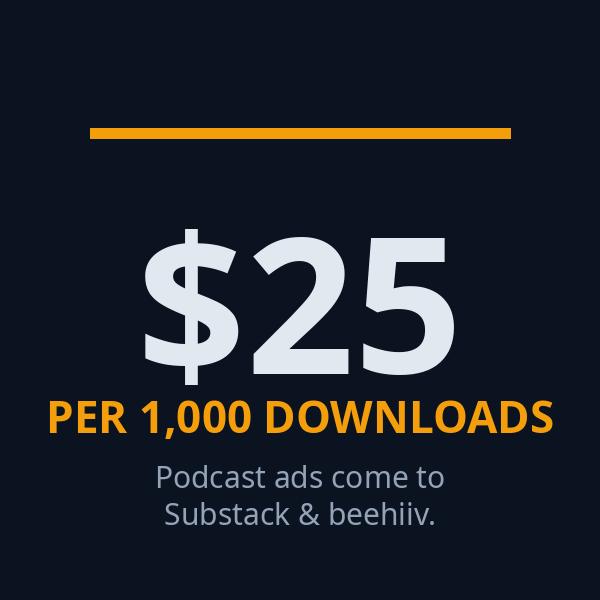
Podcast advertising is priced on CPM, the cost per thousand downloads of the episodes carrying the ad. The 2026 rates, from published rate cards and agency benchmarks, cluster like this: a host-read mid-roll — a 60-second read in the middle of the episode, where attention is highest — runs about $25 to $40 per thousand downloads. Libsyn Ads, which publishes the only full public CPM rate card among major podcast marketplaces, puts the average at $24 to $26. Pre-rolls run about $15 to $30, post-rolls about $10 to $20, and programmatic spots about $10 to $25. Host-read ads cost roughly 1.5 to 3 times the programmatic rate for the same audience, because the host's endorsement carries the ad.
Run the numbers for a small show. A solo creator whose episodes average 5,000 downloads can charge roughly $125 to $200 for one host-read mid-roll at a $25 to $40 CPM. Four episodes a month with one mid-roll each is $500 to $800 a month — real money for a one-person business, and money that arrives without adding subscribers. The same show filled programmatically at, say, a $12 CPM earns about $60 per episode, or $240 a month. The gap between those two numbers is the whole game: direct-sold host-reads pay several times more than programmatic fill, and the platforms now let a small creator do both.
The back catalogue is where dynamic insertion changes the arithmetic. A show with 100 old episodes at 500 downloads a month each is 50,000 monthly downloads of inventory that used to be worthless, because a baked-in sponsor read goes stale. With dynamic insertion, those episodes can carry a fresh ad every time someone discovers them. For a solo creator, the archive stops being a museum and starts being an asset.
Lessons: three mechanisms for a solo creator
The announcements matter less than what a one-person business does with them. Three mechanisms are worth setting up now.
-
Mark ad breaks from episode one, and treat your archive as inventory: Dynamic insertion only earns on episodes that have marked breaks. The executable version is simple: decide now where the breaks go — one mid-roll is enough to start — and mark them in every new episode, including the ones you publish before you have a single sponsor. Then go back through your most-downloaded old episodes and mark breaks there too. The guardrail is restraint: one mid-roll per episode keeps the listener experience intact, and a show that stuffs three breaks into a 20-minute episode will lose the audience the ads are supposed to monetise. The payoff is delayed but compounding. Every episode you publish from today onward is a slot that can be sold next year without you touching it again.
-
Sell host-read first, use programmatic only as fill: The CPM gap is the pricing signal. A host-read mid-roll at $25 to $40 pays roughly two to three times a programmatic spot at $10 to $25, so the order of operations matters. The executable version is to pitch five sponsors directly before turning programmatic on: companies whose products you already use, whose customers match your listeners, and who already sponsor shows like yours. Offer them the mid-roll, host-read, for a fixed number of episodes, and quote the CPM range openly. Programmatic fill is the fallback for unsold breaks, not the business itself. The guardrail is honesty about the audience: quote your real IAB-certified download numbers, not your subscriber count, and never promise a CPM you cannot deliver. A sponsor who renews is worth ten who try once.
-
Keep subscriptions as the foundation, and sell ad-free as the upsell: Both platforms say this, and the economics agree. Advertising income is volatile — it depends on the ad market, on the platform's revenue share, and on marketplaces that Substack has not even named yet. Subscriptions are the income you control. The executable version is a two-tier structure: the free feed carries ads, and the paid tier is ad-free with bonus episodes, exactly the model Substack highlights with Scott Galloway. That turns the ad launch into a subscription funnel: every ad a free listener hears is a reason to pay to remove it. The guardrail is timing. Do not put 2027 ad income into a budget yet. Substack has not disclosed its revenue share, beehiiv says only that creators keep "most of" gross programmatic revenue, and Substack's own timeline says monetisation begins in earnest in 2027. Sign up for early access, mark the breaks, and let the first real numbers arrive before you plan around them.
What is not settled
A hot event deserves a clear list of what is still unknown. Substack has not disclosed its revenue share, named its marketplace partners, or given a date for programmatic fill. beehiiv has not defined "most of" the gross programmatic revenue as a number. Early access on Substack is limited to publishers with paid subscriptions turned on, so a free-only newsletter cannot join yet. And both platforms are still building: Substack calls its sponsorship tools a preview of a broader monetisation toolkit, and beehiiv's video monetisation does not arrive until 2027.
None of that makes the announcements small. The direction is clear, and the mechanism — dynamic insertion, IAB-certified measurement, no minimums on beehiiv — is already live. What is uncertain is the price, not the existence, of the new income line.
Closing
A year ago, a solo creator with a newsletter and a podcast had one way to get paid: convince readers to subscribe. This week, the two platforms that host that business both added a second way: sell the silence between the segments. The money is not large yet — a few hundred dollars a month for a small show, and the revenue shares are still blank. But the structure is what matters. Your archive now earns while you sleep, your free feed now sells your paid tier, and the ad break you mark today can be sold again next year without you re-recording a word. The creators who benefit most will not be the ones with the biggest shows. They will be the ones who marked the breaks first.
Sources
- Introducing podcast sponsorships on Substack
- Substack Brings Dynamic Ad Insertion to Podcasts — Adweek
- beehiiv Launches Podcast Advertising Tools for Creators of All Sizes
- Giggly Squad's SiriusXM deal signals a shift from podcast networks to creator ecosystems — Digiday
- Podcast CPM benchmarks: rates by format and placement — Podder
- Podcast Advertising: How It's Bought and Sold (2026)
- Substack Adds Podcast Ad Insertion, Revenue Share Unstated — Podwires
Thematic placeholder: this hot-event article pictures no person.