Introduction
The cruelest math in modern game development belongs to a man who built six games in a year and watched ninety-two percent of the money walk out the door. In March 2025, a Chinese game developer known only as 张sir quit his studio job and bet his livelihood on one of the strangest corners of the industry: danmu interactive games — livestream games played through a video platform's comment stream, where viewers type commands in chat to control the action. Over the next twelve months, working entirely alone, he shipped six of them. By his own account in an interview with Tech星球, the six games generated nearly ¥20 million in total revenue. His personal share: roughly ¥0.8 to 1 million.
The money didn't vanish. It was split by design. On the Douyin-style platforms where danmu games live, the platform takes about 50 percent, the livestream host takes another 42 percent, and the developer — the person who designed, coded, and art-directed the whole thing — keeps around 8 percent. 张sir built a tiny factory that prints money for other people, and kept enough for himself to make it worth doing. His story is the clearest window yet into what AI has actually done to game production: collapsed the cost of making a game to about ¥1,000, shrunk a two-month team project into a fifteen-day solo sprint — and moved all the leverage to whoever owns the distribution.
The Story
张sir's background was ordinary: a working developer in China's game industry, employed, experienced, and — like so many in 2025 — watching layoffs sweep through the studios around him. He quit in March 2025, not to join another company, but to run what China now calls a 一人公司 (one-person company): a single founder amplified by AI tooling. He chose danmu games deliberately. Unlike traditional mobile or Steam games, danmu games ride on the platform's own livestream traffic — no marketing budget required, no user acquisition war chest. The audience is already there, watching; the game just needs to give them a reason to type.
What he built next was less a studio than an assembly line. A traditional ten-person team needs two to four months to ship a danmu game of comparable quality; 张sir's AI pipeline brought the cycle down to about fifteen days per title. His toolchain, described in detail in the Tech星球 interview, reads like a manufacturing spec: Doubao for keywords and concepting, Banana (an AI image tool) for original art, Triple3D or a 3D-membership service for modeling, Blender for polygon reduction, Mixamo for skeletal rigging. AI handled roughly 70 percent of the art workload. On the code side, he reported that AI wrote his Java with claimed accuracy up to 99 percent, while he focused on final assembly, UI adjustments, and engine adaptation — the integration work that still needs human judgment.
The unit economics are startling, and they are worth stating exactly. A single game costs him ¥1,000–1,500 to make, almost entirely AI-tool subscriptions and asset packs. A traditional team doing the same work would spend around ¥2 million. His most successful title, he claims, generated over ¥8 million in lifetime revenue — meaning one game built for a thousand yuan pulled in revenue roughly five thousand times its cost. And this is where the story turns honest and instructive rather than merely miraculous: of that ¥8 million, only about 8 percent — some ¥640,000 — would have flowed to him under the platform split. The ¥0.8–1M he says he actually kept across all six games sits in roughly that range, though one can note the rough arithmetic: 8 percent of ¥20 million would be ¥1.6 million, not ¥0.8–1M — the gap unexplained, likely taxes, host-partnership terms, or uneven splits across titles. Either way, the gross number is a headline; the net is the business.
And 张sir did not pretend the gross was the business. He runs a second cash flow alongside the games, and it is the least glamorous part of the story: contract work. Using the same mature AI pipeline, he takes outsourced game builds at ¥30,000–50,000 per order, roughly a week each — what he calls 旱涝保收, steady income in drought or flood. The games are the upside bets; the contracts are the floor. The split is psychologically load-bearing: when you own only 8 percent of a volatile revenue stream, you need a boring one.
He is also unsentimental about who can copy him. The one-person game studio, in his account, suits a specific founder: someone with industry experience — "有渠道" (has distribution relationships) or "懂流程、有想法" (knows the process, has ideas). AI cannot replace creativity or project management, he argues; the best moat is judgment. Beginners who can't tell whether the AI's output is correct can't correct it, so the tool becomes a liability instead of a multiplier. The barrier moved, in other words: it fell on execution and rose on taste. That is a framing worth remembering, because it explains why the AI game gold rush has produced so few winners: the technology removed the excuse, not the difficulty.
There is a final, structural lesson hidden in the danmu format itself. These games barely need promotion because they are promotions — they live inside livestreams, fed by the platform's recommendation engine, monetized by viewers tipping the host to influence the game. The host's cut, that eye-watering 42 percent, looks like theft until you realize the host is the distribution channel: no host, no audience, no game. 张sir's factory doesn't make games; it makes inventory for someone else's audience. That is the business model of every platform-era creator, from YouTubers to app developers — he just accepted it earlier and more completely than most.
Lessons
张sir's year offers three mechanics worth stealing: 1. Ship where the audience already is: danmu games need almost no marketing because the platform's livestream traffic is the marketing. Copy it: before you build, list the distribution channels that ship inside your product category — livestream platforms, app stores, marketplaces, template galleries — and build something native to one of them. If your launch plan starts with "then we run ads," you picked the wrong category. Native distribution is the only free growth left. 2. Build a personal assembly line, not a studio: his chain — Doubao for concepts, Banana for art, 3D tools for models, Blender for optimization, Mixamo for rigging — is a fixed sequence where AI does the repetitive 70 percent and he owns integration, UI, and engine fit. Copy it: write down your production as numbered steps, then automate the middle and keep the judgment-heavy first and last mile for yourself. The goal is a repeatable fifteen-day cycle, not a heroic all-nighter. Speed is a feature of process, not talent. 3. Pair a volatile upside with a boring floor: six games at an 8 percent revenue share is a lottery ticket factory; ¥30,000–50,000 contract orders at one week each is the salary. Copy it: give your risky bets a retainer-funded runway. If your creative work can't survive six months without a hit, add a service line that uses the same skills. 旱涝保收 isn't a slogan — it's a business model.
Closing
张sir spent a year building games at one-thousandth the traditional cost, watched ninety-two percent of the revenue flow to platforms and hosts, and walked away with about a million yuan and a second income stream that never depends on a hit. The AI didn't make him rich; it made him fast, and he used the speed to find the one category where distribution is free and production is personal. The headline is the ¥20 million. The lesson is the 8 percent: know exactly whose audience you're borrowing, price that into your plan from day one, and build a boring income underneath the exciting one. The factory that prints money for other people is still a factory — as long as you keep enough of what it prints.
Sources
- Tech星球:"一人公司"爆火:有人年赚百万,有人收入缩水90%(via 网易) — interview with 张sir (self-reported figures)
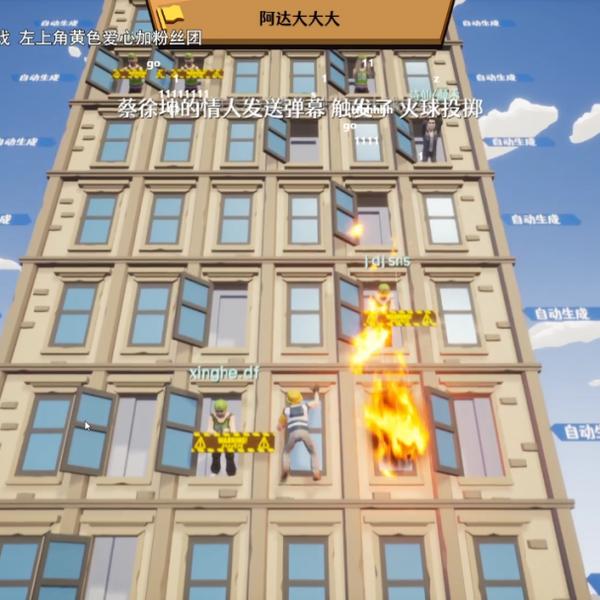
- 界面新闻:輕鬆月入數萬上十萬,彈幕互動遊戲到底是風口還是騙局 — illustration source (danmu game screenshot)
Illustration: screenshot of a danmu interactive-game livestream, via Jiemian News (a representative example — no public photo of 张sir exists).