Introduction
In 2007, an unknown 29-year-old with no platform and no audience published a book about working less. Twenty-seven publishers had rejected the manuscript. The house that finally took it printed about 10,000 copies. The book went on to spend four years on the New York Times bestseller list, was translated into 40 languages, and sold around 2.1 million copies. It also made its author, Tim Ferriss, the defining voice of a question that still drives the solo business world: what if the goal was never to work more, but to design work you do not need to escape from?
Ferriss did not start as a guru. He started as a salesman working 14-hour days at a supplements business he had built himself — and the business was eating him alive. The system he built to escape it became the book. The book made him famous enough that Silicon Valley started returning his calls, and he turned that access into early investments in Uber, Facebook, Twitter, Shopify, and Duolingo. Then, in 2014, he started asking world-class performers how they worked — and kept asking, for more than a decade, until the podcast passed one billion downloads.
This is the story of a man who turned his own burnout into a product, his curiosity into an asset, and a four-hour promise into a career that has lasted nearly twenty years.
The Story
Timothy Ferriss was born on July 20, 1977, in East Hampton, New York. He graduated from Princeton in 2000 and took what he later described as the safe first step: a sales job at a data storage company. Within a year he was building a business on the side — BrainQUICKEN, an internet company selling nutritional supplements from his apartment. It grew. And it took over his life.
By his own account, Ferriss was working 14-hour days, answering customer emails at all hours, and doing nearly everything himself. The business made money while its founder ran out of time, sleep, and patience. The breaking point was not dramatic — it was the slow realisation that the company he had built to create freedom had become a second job with a worse boss: himself.
He took a three-week sabbatical to Europe, and during that trip and the travels that followed, he built the system that would become the book. He checked email once a day. He outsourced small daily tasks to virtual assistants. He cut the 20 percent of customers and products that caused 80 percent of the trouble. The company kept running — and he got his life back. The experience became the manuscript for The 4-Hour Workweek: Escape 9–5, Live Anywhere, and Join the New Rich.
Getting it published was its own lesson in persistence. By Ferriss's own count, 27 publishers rejected the manuscript, some of them, in his telling, violently. The publisher that finally accepted it printed about 10,000 copies. Ferriss had spent nearly a year planning how to get the book noticed with almost no marketing budget: he tested titles and covers with small online ads, lined up bloggers before launch, and treated the launch like a product release rather than a literary event. The book reached No. 1 on the New York Times, Wall Street Journal, and BusinessWeek bestseller lists — and stayed on the New York Times list for four years.
The book changed what Ferriss could do next. He sold BrainQUICKEN — by then renamed BodyQUICK — to a London-based private equity firm in 2010; the price was never disclosed. The same year, The 4-Hour Body debuted at No. 1 on the New York Times list. The 4-Hour Chef followed in 2012, then Tools of Titans in 2016 and Tribe of Mentors in 2017 — five books in total, all No. 1 New York Times and Wall Street Journal bestsellers.
Fame in the book world also opened a door in Silicon Valley. Ferriss became an early investor or advisor to Uber, Facebook, Twitter, Shopify, Duolingo, and Evernote — companies that went on to reshape daily life. The pattern was consistent: he was not buying lottery tickets. He was backing products he used and understood, and his audience gave him a reason for founders to take his call.
In 2014 he started the project that would become the engine of everything after it: The Tim Ferriss Show, an interview podcast built on one simple premise. He would sit down with world-class performers — from Arnold Schwarzenegger and Jamie Foxx to Brené Brown, LeBron James, and Matthew McConaughey — and take their routines, habits, and decisions apart piece by piece. The Observer called him "the Oprah of audio." The show became the first business interview podcast to pass 100 million downloads, was picked for Best of Apple Podcasts three years in a row, and has since passed one billion downloads.
The podcast was never just a show. It was a research project with an audience. Each interview taught Ferriss something he could use, introduced him to someone worth knowing, and produced material he could repackage: Tools of Titans and Tribe of Mentors were both built from the notes of hundreds of podcast conversations. One input — a curious conversation — became a book, a network, and a deal pipeline at the same time.
Ferriss has also spent the years since the book's success funding the things he cares about. In 2018 he founded the Saisei Foundation, which funds scientific research. And he has been candid that his own thinking has moved on: the "four-hour" promise was a provocation, not a literal target, and the real goal was always the freedom to choose what to work on — not to stop working. The man who wrote the book about escaping work now says the point was designing work worth doing.
Lessons
Tim Ferriss's career offers three mechanics worth stealing:
-
Eliminate before you automate: The core of the 4-Hour Workweek is a sequence, and the order matters. First define what you actually want — in time, not money. Then eliminate: cut the customers, tasks, and commitments that cause most of the trouble and produce little of the value. Only then automate what remains, and only then free yourself from the location. Most people do it backwards: they automate a mess, then wonder why they are still busy. The mechanism is that elimination is free and automation is not — every task you delete is a task you never have to manage, outsource, or pay for. The executable version is a one-week audit: list everything you did at work, mark the 20 percent that produced 80 percent of the results, and delete or delegate one item from the other 80 percent every day for a week. If a task survives a week of questioning, it earns its place. If it does not, it was never work — it was habit.
-
Test demand with money, not opinions: Ferriss did not ask friends whether his book title was good. He ran small online ads for competing titles and covers and measured which one strangers clicked. The mechanism is that a click is a vote with a cost, and an opinion is free — people will praise an idea they would never pay for. The same logic applied to the business itself: BrainQUICKEN only became a book after Ferriss had lived the system for years and proved it worked on his own company. The executable version is a $100 test: before building anything, spend $100 on ads pointing at a landing page that describes the product and asks for an email or a pre-order. If strangers will not click, they will not buy — and you have learned that for $100 instead of six months. If they do click, you have your first customers and your first proof in the same week.
-
Turn learning into an asset that compounds: The podcast looks like a media business, but its real function is a learning machine that pays for itself. Every interview gives Ferriss new tactics, new contacts, and new material — and the same conversation becomes an episode, a chapter in a book, and an introduction to a founder worth investing in. The mechanism is that most people consume information and throw it away; Ferriss records it, organises it, and republishes it in a form other people will pay for. Tools of Titans exists because he took notes. The executable version is a weekly habit: write down the three most useful things you learned this week, who taught them to you, and where you will use them. After a year you have 150 entries — enough for a guide, a course, or a book of your own, built from material you already paid attention to.
Closing
Tim Ferriss spent his twenties building a business that worked 14 hours a day — his hours. He spent the next three years taking it apart, one outsourced task at a time, until it ran without him. The book that came out of that experiment was rejected 27 times, then sold 2.1 million copies in 40 languages. The podcast that came after it passed a billion downloads. And the man who promised a four-hour workweek now says the promise was never the point.
The point was the question underneath it: if you could design your work from scratch — the hours, the place, the people, the problems — what would you keep? Ferriss's answer was never really four hours. It was the freedom to spend the other hours on work he had chosen, with people he had chosen, for reasons he had chosen. That is a harder product to sell than a four-hour week. It is also the only one that lasts.
Sources
- Tim Ferriss (Wikipedia)
- The 4-Hour Workweek (Wikipedia)
- Guy Raz Interviews Tim Ferriss — How I Built This transcript (tim.blog)
- Tim Ferriss biography (PodSubs)
- Media Kit and Samples (tim.blog)
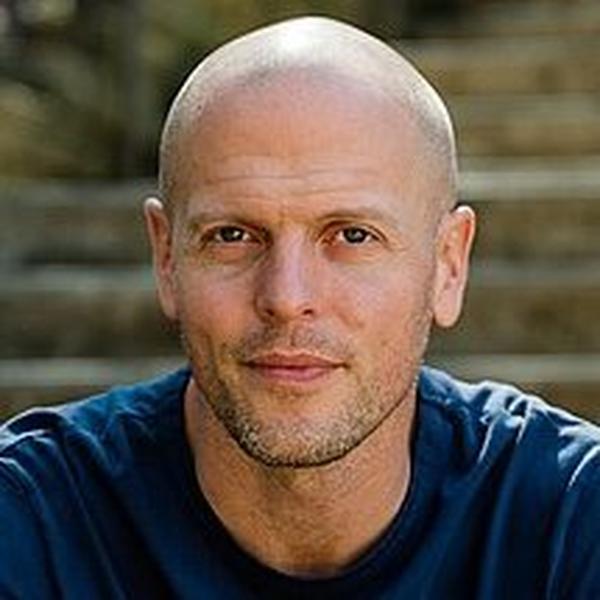
Portrait: Tim Ferriss on X (@tferriss).